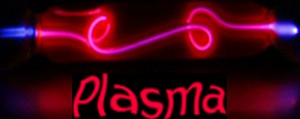
Definition: [plázmə] a hot
ionized gas made up of ions and electrons that is found in the Sun,
stars, and fusion reactors. Plasma is a good conductor of
electricity and reacts to a magnetic field, but otherwise has
properties similar to those of a gas.
(source:
Microsoft Encarta Dictionary)
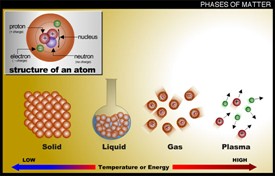
In the world of physics it's also known as
the fourth state of matter, and is the closest we can get to
"seeing" electricity. Extreme temperatures or electrical
excitation strip electrons from their normal orbit around the atom's
nucleus. This condition of free electrons allows electrical current
to flow easily, and gives off electromagnetic energy when the
electrons fall back to their normal orbits. A good example of this
is the bright orange glow from a neon gas filled sign. There are
many natural examples of plasma in our world, and many fun and
practical uses as well. We'll try to explore some examples of both
types below.
Plasma in our natural world
Let's start with the most
important example - our Sun. Without this massive thermonuclear ball
of plasma we wouldn't be here, and couldn't continue to
exist. The nuclear process that generates the Sun's energy
fuses smaller atoms, such as hydrogen, into larger atoms
that make up the periodic table of elements. This process
also causes much of the Sun's matter to be in a plasma
state, which may or may not extend all the way to its core.
Unlike a neon sign however, most of the visible light we see
is due to the
incandescent temperatures of its surface, like the
filament in a light bulb.
The Auroras are visible
displays of plasma that form at the polar regions of our
planet. They are caused by an interaction of high-energy
particles from the Sun's solar wind with the Earth's
magnetosphere. The magnetosphere is a huge magnetic field
that is generated within the Earth's core and extends far
out beyond our atmosphere. This magnetic field shields life
on earth from lethal amounts of solar radiation and is
essential to our continued existence. The auroral displays
are a beautiful show of this great protector at work.
When a storm system creates a
large enough electrical charge between clouds, or between
clouds and the ground, the air becomes ionized. Once the air
is ionized it becomes conductive and allows the built-up
charges to equalize in a spectacular display of plasma that
we call lightning. Unlike the auroral displays however,
lightning is very dangerous to both humans and property. It
is lightning that first inspired us to try to harness the
power of electricity, and for the most part we've been very
successful. As you will see though, it always deserves our
respect and should be handled with great care!
Ingenious Plasma:
Tesla's Wireless Light
- Nikola Tesla poses with a glowing lamp, but there's no
wires. The gas atoms in the bulb were excited by a nearby
radio wave generator.
Dangerous Plasma:
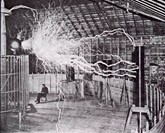
A calm Tesla sits and reads while millions of volts produced
by his resonant coil ionize the air around him. Don't try
this at home kids! The piece of equipment is known as a
Tesla Coil and is still used today on a smaller scale for
fun and educational projects.
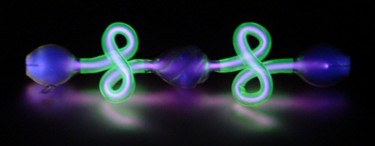
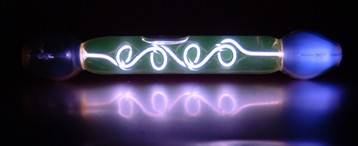
These beautiful works of art are
called Geissler Tubes. These tubes were invented in 1857 by a German
glassblower named Heinrich Geissler. They began to be mass produced
in the 1880's and were the predecessors to the more modern neon
sign.
Additional fascinating examples can be seen at
The Cathode Ray Tube Site and
The
Spark Museum.
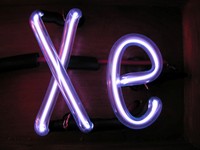
These are modern examples
of widely used neon type signs. Although they're all
commonly referred to as "neon", many use other
noble gasses such as xenon (right image), argon, or
helium to produce their light. After being bent into shape
the tubes are evacuated of air and the correct gas is then
used to refill the tube. Electrodes are attached at the ends
of the tube and sealed off. High voltage (typically 6,000 to
15,000 volts) provided from a transformer device ionizes the
gas inside and allows a small current (typically 20 to 100
milliamps) to flow through. This creates the glowing plasma
state which gives off a characteristic color for each
respective gas.
Lighting with Plasma:
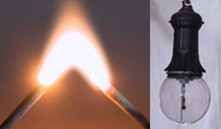
The
first form of electric lighting was the carbon arc lamp. In
1801 Sir Humphrey Davy built and displayed a crude, but
working prototype using a series of 2,000 battery cells to
achieve the necessary voltage and current. In 1876 Charles
Brush developed a more practical lamp using this idea that
could replace gas lanterns for street lighting. In some ways
this was an advancement, but it introduced new problems as
well. The lamps produced an intense glare which contrasted
greatly with the soft, pleasant glow of a gas lamp. The
arcing carbon rods gave off a soot which needed to be
regularly cleaned from the fixture glass. Also, the
extremely hot arc would burn away the tips of the carbon
rods in a very short time. This required a mechanical
clock-type mechanism to continually advance the rod tips
into the arc in order to maintain the correct arc length.
This mechanism was tricky to build and properly maintain.
The combination of all of these drawbacks gave incentive to
Thomas Edison and others to develop a simpler and more
reliable electric light.
A
much more refined type of plasma lighting is the fluorescent
lamp. Predecessors to the fluorescent lamp were gas
discharge tubes such as those by Geissler and Tesla. The
fluorescent lamp differs from these earlier lamps however,
in that it uses a phosphor coating on the glass to convert
ultraviolet light from the gas discharge into an output that
is fairly balanced in the visible spectrum. The image at
left shows an operating lamp without this phosphor coating.
The low temperature, low intensity discharge allows for very
long lamp life which currently can be up to 30,000 hours.
Relative to other electric lamps at the time of development
(around 1926), fluorescent lamps were also very efficient at
producing light per watt of electrical power. Due to
improvements in design and phosphor composition they
continue to be one of the best choices for commercial
lighting designers as well as residential home use. The
inexpensive screw-base compact fluorescent lamp is an
excellent way to reduce electric power consumption.
Modern,
large-scale outdoor lighting is almost exclusively metal
halide technology. The metal halide lamp (lower left)
combines the sealed reliability of a gas discharge tube with
the high intensity of a carbon arc lamp. This intensity is
required to illuminate large areas such as baseball and
football stadiums. This type of lamp is actually a hybrid of
the earlier mercury vapor lamp which used a short arc tube
that was made of quartz, to handle the high operating
temperature, and filled with argon gas and mercury. Upon
start-up the argon gas was ionized by the ballast
transformer voltage. As the gas heated the tube it would
begin to vaporize the mercury metal, which then also ionized
and contributed to the light output. To improve the
efficiency and color output characteristics a combination of
metal halide "salts" were later introduced (late 1960's) in
addition to the mercury. The ionization of these extra salts
not only increased the light output for a given wattage
lamp, but also helped balance the spectral light output by
producing more yellow and red in addition to the mercury's
characteristic bluish-green. The operating arc shown at the
upper left illustrates this multi-color output. Modern metal
halide lamps have a CRI (color rendering index) that can
exceed 90, with the sun being a perfect 100.
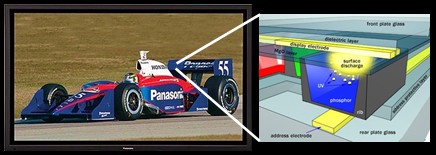
6,220,800 fluorescent lamps
turning on and off with such precision that your brain tells you
it's a Formula One race car going down a track. Full
High-Definition plasma televisions have a resolution of 1,920
pixels wide by 1,080 pixels high (1080i/1080p HD format). Each
pixel has a red, green, and blue lamp to represent the 3 primary
colors. This arrangement of lamps is controlled by a very fine
matrix of horizontal and vertical electrodes that precisely
modulates each lamp to form the image based on the incoming
video signal. The construction of these lamps can be seen in the
diagram shown. Each one consists of a sealed cell that includes
the correct phosphor, a UV generating gas, and a transparent
front opening through which its light is emitted. These cells
operate on the same principle as a fluorescent lamp, in which
the electrically ionized gas (plasma) excites the phosphor with
ultraviolet radiation causing it to glow with its respective
color. Earlier television designs primarily used a CRT (cathode
ray tube). This is a large vacuum tube that has a phosphor
coating on the front face and an electron gun in the rear of the
tube. As the electron gun "fires" a stream of electrons at the
phosphor coating magnetic coils surrounding the neck of the tube
deflect the stream in a
raster scanning pattern to form the image. Although these
tubes can produce images of very good quality the mechanism is
somewhat inexact, and not suitable for the quality demanded by
today's sophisticated consumers.
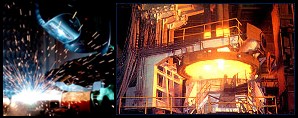
Because it can easily produce incredibly high temperatures,
and be controlled with great accuracy, plasma is used extensively
to weld, cut, and melt many types of metals. The inside of an electric arc
furnace (shown at left) is well above 3,000
°F during operation, and a welding arc can range between 3,000+
and 20,000 °F. Plasma also has the advantage that it can use the
polarity of the electric current to help draw the metal in the
desired direction.
Electric
arc furnaces are relatively simple in operation. Massive
electrodes are lowered into the furnace pot which is filled with
the solid metal to be melted. Just at the point of contact an
arc strikes between the electrodes and the metal, heating the
metal to a liquid. The process is very power hungry - consuming
60 megawatts or more for a large furnace - but is often the
preferred method for recycling scrap metal into new products.
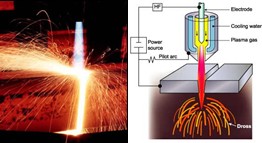
The plasma cutting process (shown at the right) is a fast and
efficient way to cut thick or very hard pieces of metal without
the friction and wear that a mechanical process would have. A
jet of inert gas or air is blown through a nozzle onto the work
piece. The nozzle acts as one electrode and the work piece acts
as the other. The jet of gas conducts the current, ionizing into
an extremely hot plasma. The plasma jet then melts the metal and
also blows it away, leaving the cut opening.
Energy from Plasma:
Harnessing the energy that powers
the stars in our universe could be one of the most important
achievements in solving the energy needs we have here on earth.
Gaseous nebula like the famous
Horsehead
Nebula pictured above are a birth-place for new stars.
Hydrogen gas in these galactic clouds can condense from
gravitational forces, and if there is sufficient mass the gas can
be compressed to the point where the atoms begin to fuse
together. At this point the mass has become a star and radiates
its own energy just like our sun. In trying to harness this
energy the goal is to reproduce the fusion process in a
controlled way that will yield a net gain of energy. The unit
shown to the right of the nebula is the TFTR (Tokamak Fusion
Test Reactor - courtesy
Princeton Plasma
Physics Laboratory). It was operated from 1982 to 1997,
achieved a controlled fusion process, and developed a world
record plasma temperature of 510 million °C. It uses a system of
very powerful magnets to contain the plasma (far right image)
that would otherwise melt through any material it would come in
contact with because of its extreme temperature. It was not able to
yield a net gain in energy however, since more power was
required to sustain the fusion process than was produced by it.
Many new technologies are currently under development, such as
the TFTR-II, Sandia National Laboratory's "Z-Machine", and
Lawrence Livermore National Laboratory's National Ignition
Facility (NIF).
Although we've come a long way, and new advancements are
happening with regularity, realistic estimates put practical
power plants using the fusion process another fifty or so years
into the future.
more links
Playing with Plasma:
decorative plasma lamps
150
years after the invention of the Geissler Tube, and more than 110
years since Tesla patented a plasma lamp, we are still
fascinated and entertained by the vision and experience of electrical
plasma.
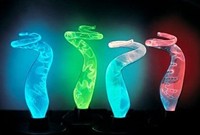
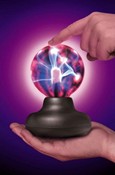
Decorative lamps such as those at the right have become a commonly
sold item in novelty and department stores. These lamps use a high
frequency, high voltage emitting electrode to ionize the gas inside
them. This gas is typically neon, argon, krypton, xenon, or some
combination of these. Touching the glass of one of these lamps while
operating will draw a discharge stream to your fingertips. This is
harmless and is due to the conductive properties of the human body.
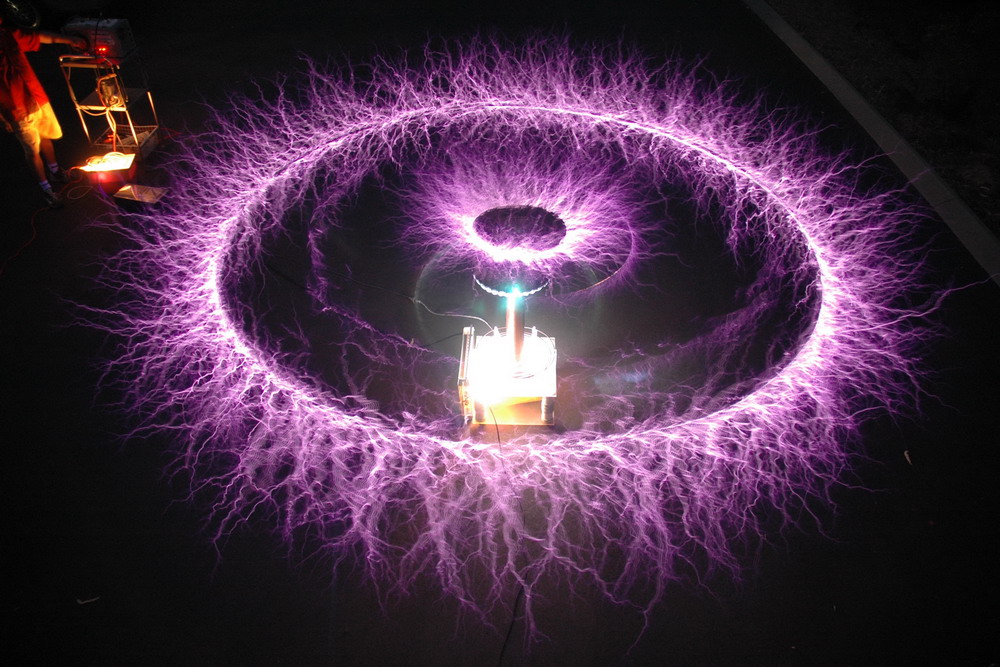
Another captivating display of
plasma is generated from a device called a
Tesla Coil.
Obviously named after its inventor Nikola Tesla, it is essentially a
high-voltage resonant transformer with a large emitting electrode at
the top end of the secondary coil. Although they have little
practical use, they are very popular for educational exhibits in
classrooms and science museums to illustrate
electrical principles. Peter Terren (Tesla
Downunder) constructs his own large Tesla Coils, and has made
their beautiful discharge into an art form. At right are images he
has created using time elapse photography to capture these amazing
patterns.
If you like to play with plasma,
and you'd like to share your experiences or images with us, send us
an
e-mail



 150
years after the invention of the Geissler Tube, and more than 110
years since Tesla patented a plasma lamp, we are still
fascinated and entertained by the vision and experience of electrical
plasma.
150
years after the invention of the Geissler Tube, and more than 110
years since Tesla patented a plasma lamp, we are still
fascinated and entertained by the vision and experience of electrical
plasma.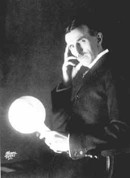

 The
first form of electric lighting was the carbon arc lamp. In
1801 Sir Humphrey Davy built and displayed a crude, but
working prototype using a series of 2,000 battery cells to
achieve the necessary voltage and current. In 1876 Charles
Brush developed a more practical lamp using this idea that
could replace gas lanterns for street lighting. In some ways
this was an advancement, but it introduced new problems as
well. The lamps produced an intense glare which contrasted
greatly with the soft, pleasant glow of a gas lamp. The
arcing carbon rods gave off a soot which needed to be
regularly cleaned from the fixture glass. Also, the
extremely hot arc would burn away the tips of the carbon
rods in a very short time. This required a mechanical
clock-type mechanism to continually advance the rod tips
into the arc in order to maintain the correct arc length.
This mechanism was tricky to build and properly maintain.
The combination of all of these drawbacks gave incentive to
Thomas Edison and others to develop a simpler and more
reliable electric light.
The
first form of electric lighting was the carbon arc lamp. In
1801 Sir Humphrey Davy built and displayed a crude, but
working prototype using a series of 2,000 battery cells to
achieve the necessary voltage and current. In 1876 Charles
Brush developed a more practical lamp using this idea that
could replace gas lanterns for street lighting. In some ways
this was an advancement, but it introduced new problems as
well. The lamps produced an intense glare which contrasted
greatly with the soft, pleasant glow of a gas lamp. The
arcing carbon rods gave off a soot which needed to be
regularly cleaned from the fixture glass. Also, the
extremely hot arc would burn away the tips of the carbon
rods in a very short time. This required a mechanical
clock-type mechanism to continually advance the rod tips
into the arc in order to maintain the correct arc length.
This mechanism was tricky to build and properly maintain.
The combination of all of these drawbacks gave incentive to
Thomas Edison and others to develop a simpler and more
reliable electric light. A
much more refined type of plasma lighting is the fluorescent
lamp. Predecessors to the fluorescent lamp were gas
discharge tubes such as those by Geissler and Tesla. The
fluorescent lamp differs from these earlier lamps however,
in that it uses a phosphor coating on the glass to convert
ultraviolet light from the gas discharge into an output that
is fairly balanced in the visible spectrum. The image at
left shows an operating lamp without this phosphor coating.
The low temperature, low intensity discharge allows for very
long lamp life which currently can be up to 30,000 hours.
Relative to other electric lamps at the time of development
(around 1926), fluorescent lamps were also very efficient at
producing light per watt of electrical power. Due to
improvements in design and phosphor composition they
continue to be one of the best choices for commercial
lighting designers as well as residential home use. The
inexpensive screw-base compact fluorescent lamp is an
excellent way to reduce electric power consumption.
A
much more refined type of plasma lighting is the fluorescent
lamp. Predecessors to the fluorescent lamp were gas
discharge tubes such as those by Geissler and Tesla. The
fluorescent lamp differs from these earlier lamps however,
in that it uses a phosphor coating on the glass to convert
ultraviolet light from the gas discharge into an output that
is fairly balanced in the visible spectrum. The image at
left shows an operating lamp without this phosphor coating.
The low temperature, low intensity discharge allows for very
long lamp life which currently can be up to 30,000 hours.
Relative to other electric lamps at the time of development
(around 1926), fluorescent lamps were also very efficient at
producing light per watt of electrical power. Due to
improvements in design and phosphor composition they
continue to be one of the best choices for commercial
lighting designers as well as residential home use. The
inexpensive screw-base compact fluorescent lamp is an
excellent way to reduce electric power consumption.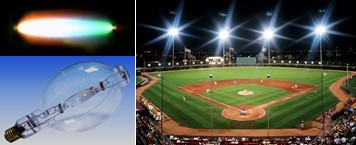 Modern,
large-scale outdoor lighting is almost exclusively metal
halide technology. The metal halide lamp (lower left)
combines the sealed reliability of a gas discharge tube with
the high intensity of a carbon arc lamp. This intensity is
required to illuminate large areas such as baseball and
football stadiums. This type of lamp is actually a hybrid of
the earlier mercury vapor lamp which used a short arc tube
that was made of quartz, to handle the high operating
temperature, and filled with argon gas and mercury. Upon
start-up the argon gas was ionized by the ballast
transformer voltage. As the gas heated the tube it would
begin to vaporize the mercury metal, which then also ionized
and contributed to the light output. To improve the
efficiency and color output characteristics a combination of
metal halide "salts" were later introduced (late 1960's) in
addition to the mercury. The ionization of these extra salts
not only increased the light output for a given wattage
lamp, but also helped balance the spectral light output by
producing more yellow and red in addition to the mercury's
characteristic bluish-green. The operating arc shown at the
upper left illustrates this multi-color output. Modern metal
halide lamps have a CRI (color rendering index) that can
exceed 90, with the sun being a perfect 100.
Modern,
large-scale outdoor lighting is almost exclusively metal
halide technology. The metal halide lamp (lower left)
combines the sealed reliability of a gas discharge tube with
the high intensity of a carbon arc lamp. This intensity is
required to illuminate large areas such as baseball and
football stadiums. This type of lamp is actually a hybrid of
the earlier mercury vapor lamp which used a short arc tube
that was made of quartz, to handle the high operating
temperature, and filled with argon gas and mercury. Upon
start-up the argon gas was ionized by the ballast
transformer voltage. As the gas heated the tube it would
begin to vaporize the mercury metal, which then also ionized
and contributed to the light output. To improve the
efficiency and color output characteristics a combination of
metal halide "salts" were later introduced (late 1960's) in
addition to the mercury. The ionization of these extra salts
not only increased the light output for a given wattage
lamp, but also helped balance the spectral light output by
producing more yellow and red in addition to the mercury's
characteristic bluish-green. The operating arc shown at the
upper left illustrates this multi-color output. Modern metal
halide lamps have a CRI (color rendering index) that can
exceed 90, with the sun being a perfect 100.